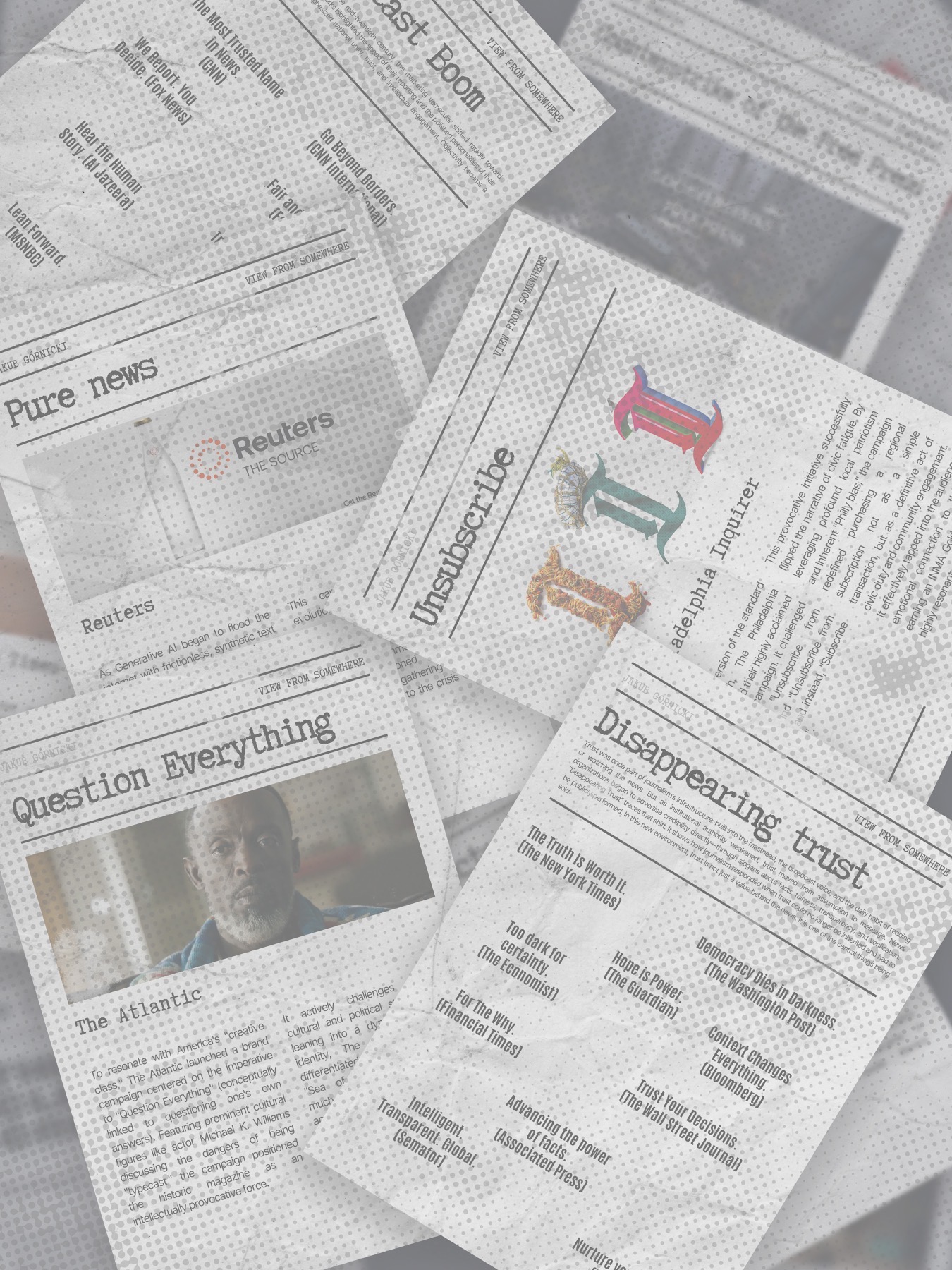
I built a wall of slogans first.
Not as decoration. As evidence. Hundreds of lines from news organisations, stripped of their logos and colours, printed in black and white, pushed against each other until the wall started to speak as one anxious institution.
Believe us. Trust us. We are independent. We are necessary. We are not like the others.
The strange thing about reading more than 4,000 journalism campaigns is that the individual slogans disappear. What remains is a texture. A professional reflex. A whole industry reaching for the same serious words at the same moment and wondering why the public does not move.
That work has now become an INMA report: How News Brands Answer: Why Should I Trust You?
The title is simple because the question is simple. Before a reader registers, subscribes, shares, pays, returns, or believes, this is what sits underneath the whole transaction: why should I trust you?
THE CLAIM HAS STOPPED WORKING
For most of journalism's history, trust was not a marketing claim. It was infrastructure. The newspaper arrived. The anchor appeared. The masthead was there because it had always been there. Trust travelled through routine, scarcity, habit, and place.
That world is gone. Search is no longer a dependable front door. Social traffic is not a relationship. News avoidance is not an abstract trend; it is a human gesture. People are tired, overloaded, and increasingly willing to cut the news out of their day.
The defensive instinct is understandable: say trust louder. Put it on the campaign. Put it on the paywall. Put it in the subscription copy. Put it in the strategy deck.
But trust has become a hygiene factor. The baseline. The wheels on the car. A newsroom announcing that it is trustworthy is like a restaurant advertising that it uses food.
The word is not wrong. It is exhausted.
A claim tells the reader what to feel. Proof gives the reader something to inspect.
That is the core move of the report: from trust as assertion to trust as visible architecture.
PROOF IS A PRODUCT PROBLEM
The report argues for something I call a proof system: the visible architecture that lets an audience understand why a piece of journalism deserves attention before the brand asks for belief.
Not a badge. Not a policy page buried in the footer. Not a film that disappears when the media buy ends. A system.
The strongest recent campaigns do this already. They show the journalists. They show the method. They show the place. They make participation run through a product the publisher owns. They make the origin of the work legible in an age when synthetic media can imitate the surface of news but not the accountable process behind it.
SURFACE_01
PEOPLE
make journalists knowable
SURFACE_02
PROCESS
show how the work was made
SURFACE_03
PLACE
prove actual presence
SURFACE_04
PARTICIPATION
give readers a real role
SURFACE_05
PROVENANCE
make origin legible
SURFACE_06
PRODUCT
keep the promise daily
These six surfaces - people, process, place, participation, provenance, and product - are not a naming trick. They are a way to force the invisible labour of journalism into public view.
THE HUMAN IS THE PROOF
AI sharpens the problem because it prices the generic correctly: at zero.
It can produce a plausible article, a plausible summary, a plausible brand line, a plausible video script, a plausible explanation of why journalism matters. It can certainly generate another campaign about truth, independence, and trust.
What it cannot cheaply generate is the human chain of accountability behind the work. Who went there? Who called the source? Who checked the document? Who changed their mind after reporting? Who signs their name? Who is reachable when the story is wrong?
That is why the journalist is no longer only a production credit. The byline is becoming a trust surface. The method note is becoming brand. The correction log is becoming a public object. The newsroom's presence in a place is becoming a moat.
This is not nostalgia for the human. It is strategy under new conditions.
TRUST IS NOT
A MESSAGE.
IT IS A RECORD.
WHAT THE AUDIENCE CAN SEE, CHECK, AND RETURN TO
MEASURE THE EVIDENCE, NOT JUST THE NOISE
The old campaign scorecard still matters: awareness, recall, preference, reach. But on their own, those numbers answer the old question. Do people know us?
The new question is harder. Do they understand why we are necessary, and can they see the evidence for it?
That requires measuring proof itself: author-page visits, clicks on "how we reported this" boxes, engagement with source notes, questions submitted by readers, repeat visits to a journalist's newsletter, trust lift among people exposed to process content. The numbers are not decoration. They are how a newsroom defends the value of human journalism when the next platform, advertiser, board, or machine asks why it should exist.
SCORECARD_01
What belief did we need to change?
SCORECARD_02
What evidence did we show?
SCORECARD_03
Did the product confirm the promise?
SCORECARD_04
Which proof surface should become permanent?
CLAIM LESS. SHOW MORE.
I do not think journalism is finished. I think one of its old languages is finished.
That is different. More useful. Less theatrical.
Journalism has reinvented its public promise every time an old source of authority broke. Print implied trust. Broadcast performed it. Cable weaponised objectivity. Digital defended democracy. Subscription funded independence. Now AI forces the next move: process has to become visible.
The strongest news brands of the next decade will not be the ones that say "trust" most beautifully. They will be the ones that make their work inspectable. People you can know. Methods you can see. Places you can feel. Origins you can verify. Products that keep the promise after the campaign ends.
The report is available through INMA. I hope people in newsrooms read it less as a marketing document and more as a provocation to rebuild the public face of the work.
Because the audience is not asking for another slogan.
It is asking to see the work.
Read the full INMA report: How News Brands Answer: Why Should I Trust You?
OPEN REPORT